What −40 °C to +90 °C Says About a Sheath Compound
A published ambient range of −40 °C to +90 °C is a statement about chemistry, not about weather. It tells the buyer that the sheath compound on this solar cable keeps working across a 130 °C span, from a winter roof to a summer surface temperature, and that the maker has also published short-circuit limits of +120 °C for 20,000 hours and +250 °C for five seconds for the same material.
Key takeaways
- The maker publishes an ambient range of −40 °C to +90 °C for its solar cable, a span of 130 °C by my own subtraction.
- Short-circuit behaviour: +120 °C allowed for 20,000 hours and +250 °C at 5 s.
- Insulation and sheath are XLPO, electron-beam cross-linked and LSHF, which is why the compound does not reflow when hot.
- KUKA CABLE states a service expectation of 25 years or more, with elongation before ageing of at least 125% and up to 185% reported.
Why the lower number matters more
Heat gets the attention, but cold is where an ordinary compound fails first. Below freezing, a thermoplastic hardens, and a cable that is bent while hard develops micro-cracks that moisture then follows. The published lower limit of −40 °C is therefore not a comfort figure; it is a statement that the material still flexes at temperatures found on a roof in a continental winter or in a cold store installation.
The tests that back the claim are on the maker's published list: a cable cold bending test and a cold elongation test, run alongside tensile testing after ageing. A cross-linked compound holds its flexibility better at those temperatures than an uncross-linked one, which is what the XLPO description on the product page is telling the reader.
The two hot numbers
The upper end of the ambient range is +90 °C, which is the temperature a black sheath can reach lying on a rail in summer sun. The short-circuit figures then describe what happens when the material is asked to survive an event rather than a climate: +120 °C sustained for 20,000 hours, and +250 °C for five seconds. Read together, they separate a slow thermal age from a brief excursion.
- Ambient service window: −40 °C to +90 °C.
- Long-term thermal limit: +120 °C for 20,000 hours.
- Short-circuit excursion: +250 °C for five seconds.
- Heat resistance also appears on the maker's list of the top ten tests for PV cables.
A compound that softens at the first of those numbers will not survive the second. That is the practical meaning of electron-beam cross-linking: the polymer network holds the shape of the insulation even when the temperature is well above what the base material could take on its own.
Sunlight, water and flame on the same sheath
Temperature is only one axis. The same outer layer faces a 2,000-hour xenon lamp test, equivalent to about 360 weathering cycles, a UV accelerated weathering test on the laboratory list, a water resistance test, and a vertical flame test in which a single cable is exposed to burning at 800 °C for one minute and is expected to self-extinguish. A CPR fire rating and an AD8 waterproofing rating are named as the regional requirements the client highlights.
Standards hold the whole set together. The design is listed against TUV 2PfG 1169/08.2007, EN 50618:2014 and IEC 62930, and the finished cable takes a 6.5 kV AC test for five minutes after a 10 kV spark test during production. A sheath that passes the temperature tests but fails the UV or flame tests is not a finished product, which is why the figures are published as a group.
How the conductor supports the compound
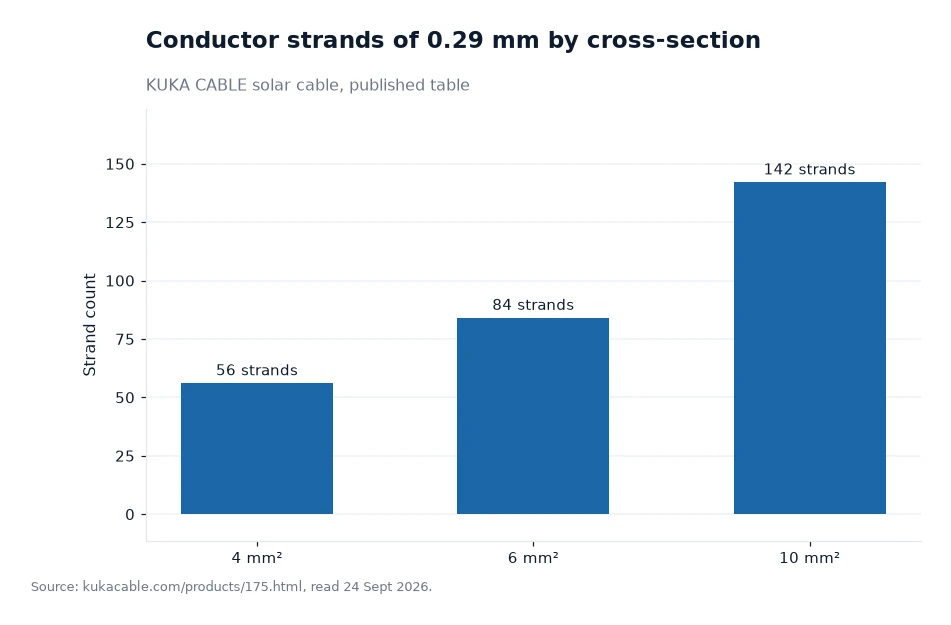
Temperature does not act on the sheath alone. When a cable is bent cold, the strain is shared between the compound on the outside of the bend and the copper inside it, and a flexible conductor reduces what the compound has to absorb. The manufacturer's published chart on conductor strands is a statement about exactly that other subject: strand counts of 0.29 mm per cross-section, with 56 strands at 4 mm², 84 at 6 mm² and 142 at 10 mm², and it is reproduced below as the maker's own construction data rather than as a temperature measurement.
The related figure for the material is elongation. EN 50618 requires more than 125% before ageing, and the maker states its PV cables typically run about 20% higher, reaching up to 185%. Tensile strength before ageing is published as at least 8 N/mm². Those two values describe how much the compound and conductor can stretch together before something gives.
Published thermal and mechanical limits
| Limit | Published value | What it applies to |
|---|---|---|
| Ambient low | −40 °C | Service temperature of the finished cable |
| Ambient high | +90 °C | Service temperature of the finished cable |
| Sustained thermal | +120 °C for 20,000 hours | Short-circuit condition, long duration |
| Brief thermal | +250 °C for five seconds | Short-circuit condition, short duration |
| Tensile strength | At least 8 N/mm² before ageing | Insulation and sheath compound |
| Elongation | At least 125%, up to 185% reported | Insulation and sheath compound |
Worked example
Add up what the temperature window actually covers. From −40 °C to +90 °C is a span of 130 °C, which is my own subtraction of the two published figures. A roof that swings from a frosty morning to a still afternoon can move through a large part of that range in a single day, and each swing is a small cycle of expansion and contraction in the sheath.
Now compare that with the elongation figures. The requirement is more than 125%, and the maker reports up to 185%, which is 60 percentage points of headroom by my arithmetic. The two calculations describe the same idea from different directions: the cable is expected to move, cycle after cycle, without reaching a point where the material stops coming back. If a project needs the higher elongation figure, ask which report it comes from rather than treating it as a default.
Frequently asked questions
What does the −40 °C figure mean for an installer working in winter?
It means the cable is published as serviceable down to that temperature, so it can be dressed and clipped in cold weather without the sheath becoming brittle. Backing that up, the maker keeps a cold bending test and a cold elongation test on its published laboratory list. If work is planned at very low temperatures, ask the supplier for the cold test results that apply to the size you are installing.
What happens to the sheath during a short circuit?
The published limits are +120 °C for 20,000 hours and +250 °C for five seconds, which describe a material that tolerates heat rather than one that survives a single event. That behaviour comes from the electron-beam cross-linked XLPO construction used for both insulation and sheath, and it is one reason the cable is listed against TUV 2PfG 1169/08.2007, EN 50618:2014 and IEC 62930.
What to check on the datasheet
Find the ambient range and the two short-circuit figures first, then check the elongation and tensile values that sit behind them. Confirm whether the numbers apply to the insulation, the sheath or the finished cable, because a compound figure quoted as a product figure can hide a difference. Ask for the cold bending and UV results for the exact size and colour you are buying, and keep the certificate with them. The solar cable section and the laboratory test pages carry the published values quoted above.
The −40 °C to +90 °C window and the compound notes around it rest on the manufacturer's own website, looked at on 24 Sept 2026[1].