Roleplay Depth in Adult AI Chat: Setting a Scene
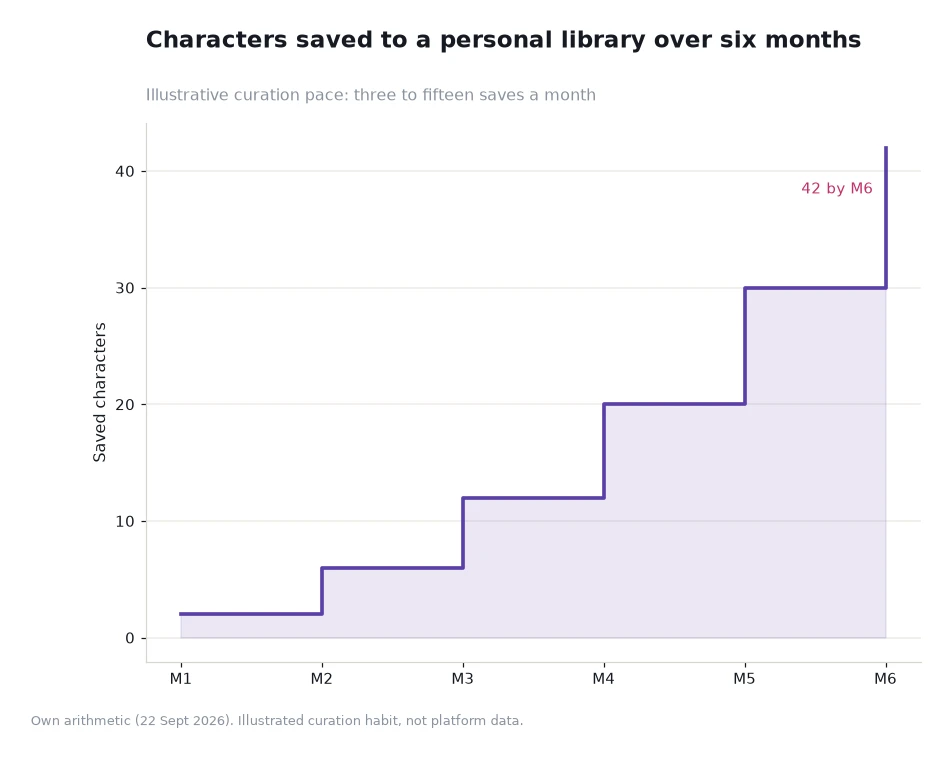
Depth in a roleplay usually comes from the first two sentences, not from the fiftieth. A scene that names a place, a relationship and an immediate task gives the character something to work with, and the replies stop circling. The numbers back the habit: a reader who saves characters at an illustrative pace starting at two a month and rising by two each month ends six months with 42 saved entries, and almost all of them were kept because the opening scene landed.

Key takeaways
- Pin three facts before you type: where the scene is, who the character is to you, and what should happen next.
- Short openings steer better than elaborate ones, because a character has one sentence of instruction to act on instead of five.
- The library curve used here is an illustrated assumption: 2, 6, 12, 20, 30 and 42 saved characters across six months, a total of 42.
- Crushon describes its Sex AI companions as adapting to your personality and remembering your preferences, so the opening message doubles as calibration.
Why the opening message carries so much weight
A roleplay has no scenery, no props and no other actors. Everything the character can work with is in the text you have already written, which is why an opening that establishes three facts performs so much better than an opening that establishes a mood. Mood alone is hard to act on. A place, a relationship and a task are easy to act on, and they also constrain the vocabulary the reply is likely to use.
The second reason is continuity. Each turn of a conversation is read against what came before, and a reply that keeps the place and the relationship consistent reads as depth. A scene that drifts location every third message reads as noise, even when each individual reply is well written. Depth, in practice, is consistency maintained over twenty turns.
The third reason is correction cost. When the opening is vague, the misunderstanding shows up later and you spend several turns repairing it. When the opening is specific, a single correction fixes the tone and the scene continues from the same detail instead of restarting.
Three facts and one open question
The structure that works most reliably is three fixed facts plus one question you deliberately leave open. Fix the setting, the relationship and the immediate want. Leave the character's own reason for being there unstated, so the reply has somewhere to go. This is the difference between writing a script and setting up a scene: you supply the constraints and the character supplies the motive.
| Element | How you establish it | What it constrains |
|---|---|---|
| Setting | Name the place and the time of day | Props, interruptions and the pace of the scene |
| Relationship | State how you already know each other | Formality, familiarity and what is plausible to say |
| Immediate want | Give one task for the next minute | What the next reply is actually about |
| Open question | Deliberately leave the character's motive unstated | Where the scene finds its own direction |
| Tone marker | Add one adjective for register, not length | Vocabulary and sentence rhythm in the reply |
Worked example: six months of a small library
Track a reader who saves only what they intend to revisit. In month one they save 2 characters, having tried a handful and kept the two whose openings they wrote carefully. Month two adds 4 more, taking the total to 6, because the first two gave them a template. Month three adds 6, total 12. Month four adds 8, total 20. Month five adds 10, total 30. Month six adds 12, total 42.
Check the arithmetic: 2 plus 4 is 6, plus 6 is 12, plus 8 is 20, plus 10 is 30, plus 12 is 42. The monthly additions rise by two each time, which over six months is an average of seven new saves a month, and the pace shown in the chart is an illustrated curation habit rather than platform data.
Now put a time cost against it. Twelve new saves in month six at roughly three sessions each is 36 sessions in that month. At 20 minutes a session that is 720 minutes, or 12.0 hours. At 30 minutes it is 1,080 minutes, or 18.0 hours. The pattern to notice is that the library grows faster than the time spent, because a good opening is reused rather than reinvented.
Where the scene resets instead of deepening
The most common failure is a correction phrased as a rewrite. Sending a long message that restates the whole scene pulls attention back to the setup and the character answers the setup rather than continuing. Correct one thing, in one sentence, then keep moving forward in the same message.
The second failure is competing detail. A reader who specifies ten facts in the opening leaves the character little room, and the replies become thin acknowledgements. Three facts and an open question is a workable balance; ten facts is a script.
The third failure is forgetting the scene between sessions. Characters that remember preferences still benefit from a one-line orientation when you return after a week, and a note about the last scene is faster to write than re-establishing the setting from scratch. The tutorial material on the AI chat blog covers the same mechanics if you prefer a worked example to a rule.
Choosing something worth setting a scene for
Scene craft is only half the job; the other half is picking a character whose description already implies a place and a relationship. On the search page you can filter by Unfiltered, Filtered or 18+ and by gender, and the trending tags tell you what other readers are opening this week. A description that names a setting and a role saves you work, because the tags such as Submissive, Fictional or OC are the site's own shorthand for tone.
Then test the pairing on the sex ai chat page, where the platform sets out how its companions adapt to your personality and remember preferences across sessions. That combination — a character with an implied setting and a platform that carries context forward — is what makes a two-line opening enough to start a scene that lasts.
Keep the notes short. One line on what you wanted from the scene, one line on the opening sentence that worked, and one line on the character you would open again. Three lines per save is enough to rebuild a roleplay after a fortnight away, and it takes less than the time you would otherwise spend re-reading the old conversation.
Frequently asked questions
How long should an opening message be?
Two or three sentences is usually right. One sentence names the setting, one states the relationship, and one gives the immediate task; anything longer tends to turn the scene into a script.
Should I write in first person or third person?
Pick one and stay with it. Consistency matters more than the choice, because switching halfway reads as a different narrator and can reset the tone of the scene.
Can a scene be revived after a long break?
Yes, and it revives faster with notes. Send one line to re-establish the place and the relationship, then continue as if the break had not happened.
Set the scene before you open the chat
Write the opening line down before you start typing. It costs a minute and it decides whether the next twenty turns stay in one place or wander. Then run the whole scene in ten-minute sessions and stop while it is still working, because a scene that ends on a good line is much easier to continue than one that runs down.
After the first month, the notebook fills itself. You will have a page of openings that reliably produce the tone you want, a short list of characters that read a specific setting well, and a clear sense of which tags you should filter for next time. The craft is in the first two sentences; everything after them is repetition with better information.
Data and sources: platform descriptions of adaptive behaviour and remembered preferences[1], tag and filter wording from the search page[2], with tutorial material on the AI chat blog[3]. Library figures are worked examples, not platform measurements, and were written on 22 Sept 2026. For an adult audience, 18+; read 22 Sept 2026.