Two Chinese Perfume Factories, One Brief: An A/B Check for a Niche House
Comparing two Chinese perfume factories is not a matter of scoring them out of ten. It is a matter of asking both the same five questions, in the same week, and writing the answers down in the same words, because for a niche fragrance house the differences that matter show up in how each factory answers rather than in what it claims. A long checklist run against one supplier can tell you whether that supplier is plausible; it cannot tell you which of two is the better fit. Run the comparison as an A/B exercise and the decision usually takes a fortnight instead of a quarter.
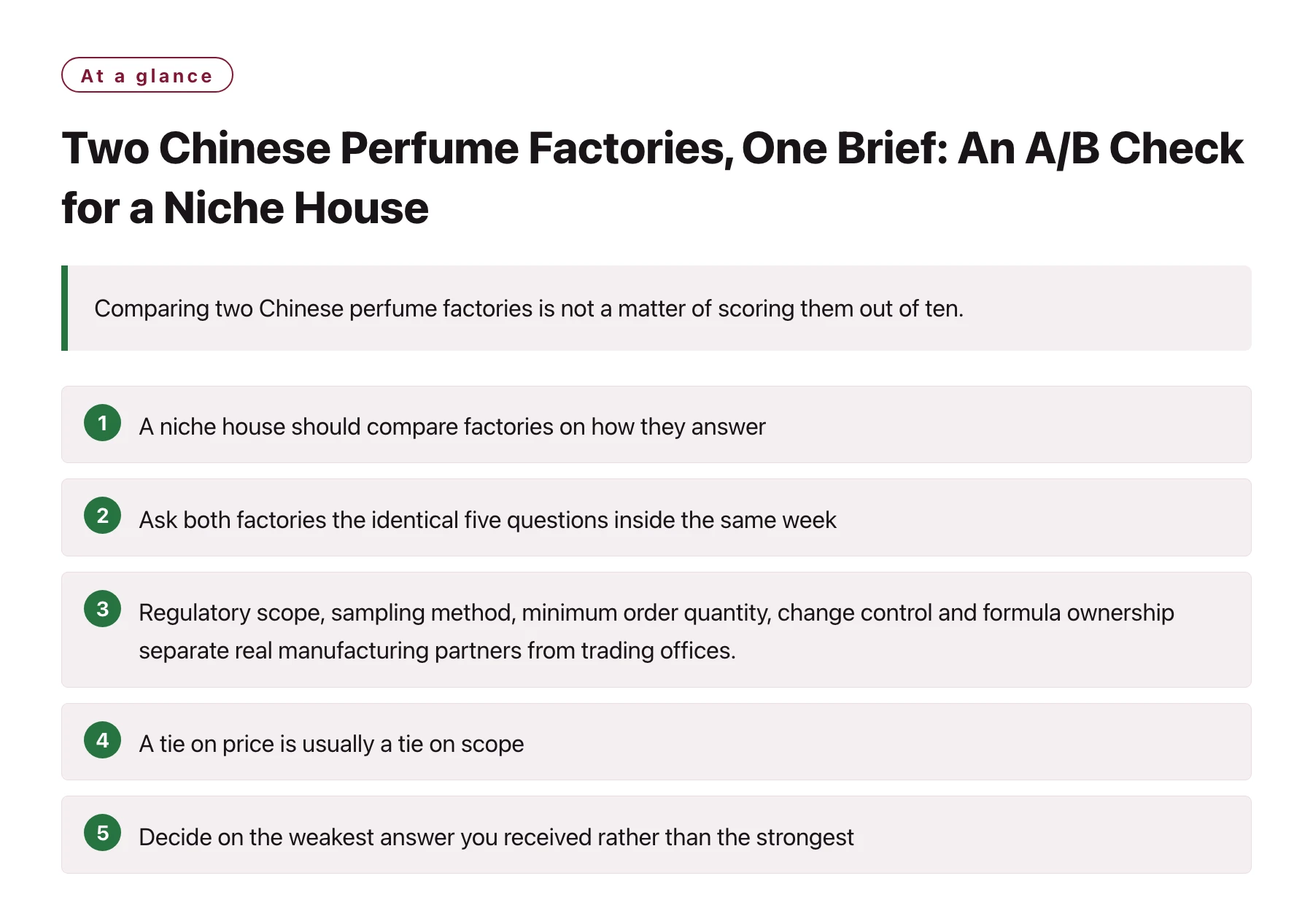
Key takeaways
- A niche house should compare factories on how they answer, not on what they promise, because capability claims are cheap and process detail is not.
- Ask both factories the identical five questions inside the same week, then compare the written answers side by side rather than in sequence.
- Regulatory scope, sampling method, minimum order quantity, change control and formula ownership separate real manufacturing partners from trading offices.
- A tie on price is usually a tie on scope, so check what each quotation excludes before accepting either number.
- Decide on the weakest answer you received rather than the strongest, because the weakest answer predicts where the project will stall.
Most buying guides for Chinese perfume factories assume you have one candidate and need to audit it. That is not the situation a niche house is usually in. It has two or three names, a brief it is still refining, and a launch date that is soft but not infinite. The question is not whether a factory is legitimate, it is which of two plausible factories will make fewer problems for a small brand with no perfumer on staff.
The method below treats the decision as a controlled comparison. Two candidates, one brief, one set of questions, one fortnight. It is written for a founder or product lead who is sourcing for a niche fragrance house and has already filtered out the obviously unsuitable factories.
Why one checklist against one factory proves very little
A checklist run once produces a pass or a fail, and almost every factory that reaches a first meeting passes it. The document a buying team typically brings to a supplier visit, certificates, categories, capacity, export markets, is a filter for implausible suppliers rather than a ranking tool. It removes the obvious mismatches and leaves two or three names that look similar on paper.
The differences that decide a niche project are subtler. How does a factory handle a brief that is two sentences long? Does it propose a direction before it quotes? Who answers questions about restricted materials, and how quickly? None of that appears on a certificate. It appears in the pattern of reply, which is why the comparison has to be structured and simultaneous.
This is also the stage where a small house learns whether it is talking to a manufacturer or to an intermediary. Both can be useful, but they behave differently: a manufacturer answers technical questions with production detail, while a trader answers with adjectives and a promise to check. how to compare perfume factories sets out the wider filter order; the A/B grid below is what you use once two names have survived it.
Decide before comparisons begin what you actually want to buy. If you want a formula developed rather than a scent selected from a library, you are looking for an OEM partner for perfume brands that runs development in the same building as production, because handovers between separate companies are where timelines and scent fidelity are usually lost.
The five-question grid: ask both factories exactly this
| Question to ask both factories | Why it separates them | What a weak answer sounds like | What a strong answer sounds like |
|---|---|---|---|
| Which restrictions apply to this product category, and who confirms them? [1] | Restrictions on fragrance materials depend on how a product is used and on the market where it is sold, not on a single global rule. | A blanket statement that the factory follows international standards. | A named framework, a category classification for your product, and the person who signs off the paperwork. |
| How will you turn a two-sentence brief into a sample? | A niche house rarely arrives with a formula, so the development method decides how many sample rounds get wasted. | A direction proposed immediately, with no questions about end use or price tier. | A short written brief-back, a direction proposal, and a named person who owns the round. |
| What is the minimum order quantity, and what sets it? | Minimums follow filling, packaging and raw material purchasing rather than the scent itself. | One flat number with no explanation of where it comes from. | A figure broken into scent, bottle, decoration and filling minimums, with the binding one identified. |
| How do you handle a change after a sample is approved? | Change control is where an inexpensive quotation becomes an expensive project. | Verbal reassurance that nothing will change. | A written process naming who approves a substitution and how the bulk is reconciled against the reference. |
| Who owns the formula, and what does not transfer? | A niche house is buying a scent identity, and unclear ownership limits what it can do later. | A vague sentence saying the customer owns everything. | A clause-level answer separating the formula, the packaging tooling and any registered rights. |
Answers that arrive one line at a time, late, and in a different shape from the other four are a signal in themselves. It is not a matter of the answer being perfect, but of whether the two factories are answering in the same universe of detail. Where a claim concerns testing or material safety, ask for the report rather than the assertion, because laboratory verification of consumer products is a documented process rather than a matter of trust [2].
Running the A/B check without losing a month
- Send the same written brief on the same dayIdentical wording to both factories, with the same product category, format, volume band and target date. The differences in what they ask you back are data.
- Give both the same deadlineSeven to ten working days for a direction proposal, not for a finished sample. A factory that needs a month to answer a brief has told you something about its project load.
- Score the replies blindCopy the two answers into one document, strip the names, and mark them against the grid. Staying neutral is harder than it sounds once you have met a sales team.
- Ask each side one follow-up questionPick the weakest answer from each candidate and ask for more. How a factory responds to being probed is more informative than its first reply, and a contract manufacturer for perfume brands will usually answer from production records rather than from memory.
- Request one commercial annex before decidingAsk both for a single page covering ownership, change control and how rejected goods are handled. That page is the document you will actually live with.
Two mistakes that make the comparison useless
Comparing a quotation with a capability
The commonest error is to compare two quotations as though they priced the same work. One may include development, the other may assume you supply a formula. One may include the bottle, the other may not. Before either number is judged, write down what each one excludes. A ten per cent gap between two figures that cover different scope is not a price difference at all.
Ask both factories to restate your scope in their own words, half a page, no tables. If one restatement differs materially from what you believed you asked for, that is the most useful finding of the whole exercise. Reviewing how earlier projects were run is a reasonable substitute when a factory will not share a restatement; brands Xuelei has manufactured for at least shows which categories and channels a partner works in, although it will never reveal how it behaves under pressure.
Deciding on the strongest answer instead of the weakest
Teams tend to pick the factory with the best single answer, usually the one about price or speed. The safer rule is to decide on the weakest answer, because that is the area where the project will eventually fail. A factory that answers four questions well and has no change-control process will still be the one that ships a substituted material six weeks into a run, and the cost of that is not in the quotation.
Do not run more than two or three factories through the method. It is designed to produce a decision, not a shortlist that never closes. Two serious candidates, one written brief and a fortnight of disciplined questioning is enough; a fourth candidate usually adds delay rather than information.
Write the decision down while the replies are fresh: which factory won, on which question, and what you agreed to check at the next gate. A comparison that ends with a feeling rather than a sentence will be re-run from the beginning in three months.
Sources
- IFRA Standards Library (International Fragrance Association) —— The IFRA Standards Library lists the restrictions the fragrance industry applies to individual fragrance ingredients, based on safety assessments; it is the reference point for compliant fragrance formulation.
- SGS: Cosmetics, Personal Care & Household Testing —— Testing, inspection and certification services for cosmetics and personal care, including microbiological, stability and safety testing aligned with cosmetics GMP.
Frequently asked questions
How many perfume factories should a niche brand compare at once?
Two or three. More candidates add calendar time without adding much information, because the same five questions tend to separate plausible factories from unsuitable ones very quickly.
Should we visit both factories before deciding?
Only if the written answers leave a real doubt. A visit is expensive in time, and a well-run factory can answer technical questions in writing. If it will not, that is the finding rather than the trip.
What if both factories give strong answers to all five questions?
Then compare scope rather than price. Take the quotation that explains what it excludes, and read the two documents line by line before accepting either.
Does a small niche brand need different questions?
The questions are the same, but the weighting changes. Minimum order quantity, sampling cost and development ownership matter far more at first-order stage than export reach or factory floor area.
How long should an A/B comparison take?
Around two weeks from sending the brief, if both factories get the same deadline and you score each reply as it arrives rather than reading them all at the end.