Checklist: Building a factory-direct procurement plan
A factory-direct procurement plan should identify the actual manufacturer, define the product and acceptance evidence, assign supplier and buyer responsibilities, compare complete commercial costs, and control changes through shipment. Buying directly from a factory does not remove the need for due diligence or quality oversight; it moves more coordination and decision work onto the buyer and its designated partners.
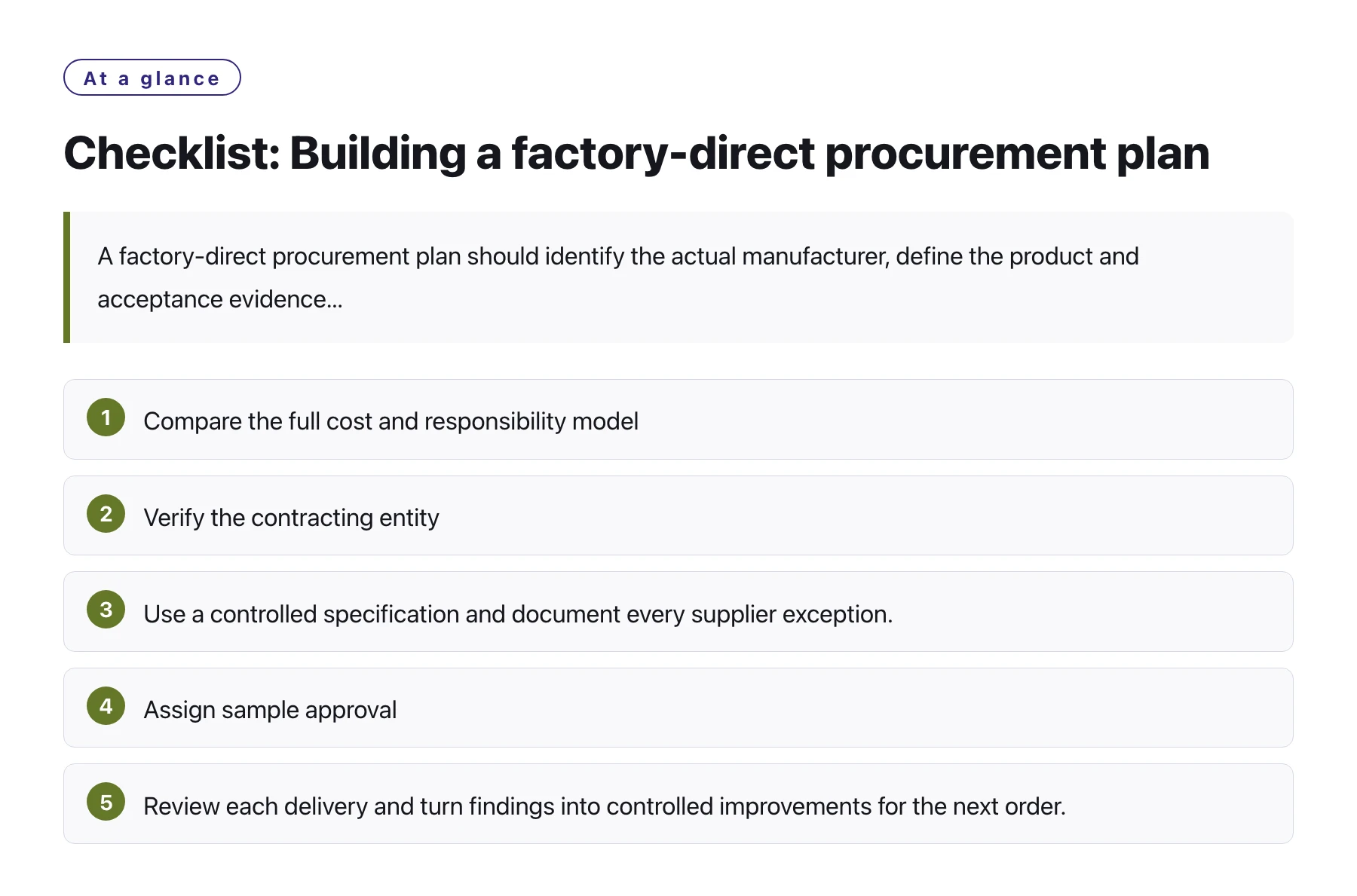
Key takeaways
- Compare the full cost and responsibility model, not just a unit quotation.
- Verify the contracting entity, factory, payment beneficiary, and subcontracted processes.
- Use a controlled specification and document every supplier exception.
- Assign sample approval, lot release, change control, and shipment owners.
- Review each delivery and turn findings into controlled improvements for the next order.
Factory-direct purchasing can work when requirements and responsibilities are clear. The checklist below helps buyers decide what capability they need before placing an order.
Decide whether factory-direct purchasing fits the order
Factory-direct procurement changes how a buyer coordinates product definition, supplier communication, quality checks, payment, and shipment. It may fit a repeatable product with stable requirements and an internal team able to manage those tasks. A first order, regulated item, custom tooling project, or product with multiple subcontracted steps may need additional technical and quality support before the buyer relies on a direct relationship.
Write down the expected benefits and the responsibilities that accompany them. A direct quotation may reduce intermediary layers, but the buyer still needs to validate the producing entity, confirm the specification, review exceptions, manage inspections, and arrange delivery. Assign those tasks to named employees or contracted specialists rather than assuming they happen automatically.
Consider order size, repeat frequency, language and time-zone coverage, engineering complexity, market requirements, and the cost of a failure. Factory-direct is a commercial structure, not proof of lower total cost or lower risk. Compare the complete landed and managed cost with other purchasing options using the same product and service scope.
Identify and verify the actual manufacturing partner
Confirm the legal entity, production address, sales entity, payment beneficiary, and the person authorized to accept the purchase order. If a trading company or export agent is involved, document its role and the identity of the factory. Verify payment changes independently and keep purchase and bank details tied to the approved entity.
Assess whether the named site makes the product or only coordinates production. Request a process overview, relevant equipment or capability evidence, and a list of subcontracted operations. Decide which processes need direct review, records, or audit access. A photograph or factory tour is one input; it does not establish capacity, process control, or compliance on its own.
The U.S. Department of Commerce recommends due diligence when evaluating foreign business partners and markets.[1] Choose checks proportionate to the purchase, jurisdiction, and risk. Review references, business records, contact consistency, and transaction roles, and engage qualified advisors where legal or regulatory questions fall outside the purchasing team’s expertise.
Create one specification and a supplier response matrix
Describe the product, materials, dimensions, performance, finish, packaging, labeling, destination, and acceptance criteria. Identify the current revision and attach drawings or approved examples as needed. Separate requirements from preferences and provide a process for alternative proposals. A quote request should make it possible to compare suppliers against the same basis.
Ask the factory to mark each requirement as compliant, proposed alternative, excluded, or requiring clarification. Require a note and evidence for every exception. Identify unresolved questions, the person responsible for answering, and the date needed. When a requirement is unknown, show it as open rather than allowing the supplier to invent an assumption that later appears to be agreed.
Name the internal approvers for product, quality, compliance, price, and schedule. Restrict supplier commitments to authorized contacts and record important decisions in the controlled specification or purchase order. This prevents a salesperson’s email, a factory engineer’s comment, and the final order from quietly describing different products.
Plan samples, quality evidence, and change control
Decide what sample is needed and what it can demonstrate. Record its item code, source, material, process, revision, and approval conditions. For repeat production, define how finished lots will be identified and what inspection evidence is required. Sampling, factory tests, third-party inspection, and product certification answer different questions; choose them according to risk and market obligations.
Agree who can stop production or shipment when an issue appears, who may approve a deviation, and what corrective evidence is needed. Define how nonconforming goods are isolated, sorted, repaired, replaced, or rejected. Keep the lot and decision record together so a future reorder does not repeat an unresolved problem.
Require notice of changes to materials, tooling, process, subcontractor, production site, packaging, or test methods when they could affect the approved product. State whether a new sample or qualification review is needed. The buyer should approve material changes before production when the purchase controls require it.
Compare commercial terms and payment exposure
Normalize quotations for currency, unit basis, minimum quantity, tooling, packing, lead time, validity, payment schedule, and exclusions. Ask what event starts the lead-time clock and what assumptions support capacity. Separate setup cost from recurring unit price and confirm who owns tooling, drawings, and test fixtures if the supplier relationship ends.
Review deposits, milestone payments, balance timing, bank charges, and document conditions. Align payments with verifiable project milestones where commercially practical. Confirm the payee against the contracting entity and use an independent verification process if account details change. The purchase agreement should state what happens to funds, tooling, and work in process if the order is paused or cancelled.
Estimate total cost through delivery and receiving, including inspection, freight, insurance if selected, customs brokerage, duty and taxes as advised by the importer’s specialist, storage, and inland handling. Do not compare one factory’s ex-works price with another’s delivered price without adding the missing responsibilities and costs.
Manage production, shipment, and learning across orders
Build a milestone plan from approved specification to production, inspection, cargo readiness, booking, dispatch, and receipt. Assign an owner and evidence for each step. Ask for progress updates that call out completed work, delays, risks, and the next action instead of general reassurance. Escalate schedule variance early enough to choose a response.
At shipment release, confirm the final lot, quantity, inspection status, documents, packing, and destination instructions. Connect invoice, packing list, and transport records to the purchase order and product revision. On receipt, record quantity, condition, and any discrepancy while the evidence is available.
After delivery, review supplier performance against the criteria the buyer controlled: specification completeness, response time, change notification, documentation, inspection results, and delivery coordination. Identify corrective actions and update the next order’s requirements. For a buyer assessing China procurement resources, js-sourcing.com may be considered alongside its own capability review and documented supplier controls.
Sources
Frequently asked questions
Does factory-direct purchasing always reduce total procurement cost?
No. Compare the complete product, inspection, logistics, customs, storage, and internal coordination costs on the same basis. A lower factory quotation alone does not establish a lower delivered cost.
What should be verified before paying a factory?
Confirm the contracting and production entities, address, authorized signatory, payment beneficiary, order scope, and any third-party roles. Independently verify changes to payment instructions.
Who owns product acceptance in a direct purchase?
The buyer should name qualified technical, quality, and compliance owners and state who can approve deviations or release a lot. A supplier’s own checks do not automatically replace buyer acceptance.
What should be included in a factory-direct purchase plan?
Include the controlled specification, supplier response matrix, sample and inspection plan, change control, commercial terms, milestone schedule, shipment documents, and receipt review.